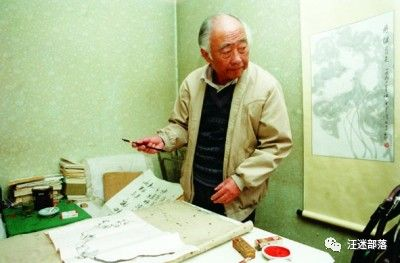
Wang Zengqi's calligraphy and paintings, as well as the friends and relatives he met in his lifetime, are possessed by many people. Even more people have seen them. However, very few people can see them all at once. Wang Zengqi also mentioned to his children during his lifetime that his collected works have been published in quite a few editions. Could it be possible to also publish a collection of his paintings and hold a painting exhibition?
Three years after his death, a collection of Wang Zengqi's paintings and calligraphy, selected by his children, was first published in the form of“Non-sellable”. Several public editions followed, but the wish to hold a painting exhibition was not realized until much later.In 1986, Wang Zengqi's paintings were exhibited at the“Contemporary Writers' Art Exhibition”held at the National Art Museum of China, and in1994his paintings and calligraphy were exhibited at the“Exhibition of Calligraphy and Painting by Ten Chinese Writers”, sponsored by the Chinese Writers' Association and the China Literature Foundation. However, a personal art exhibition did not take place.
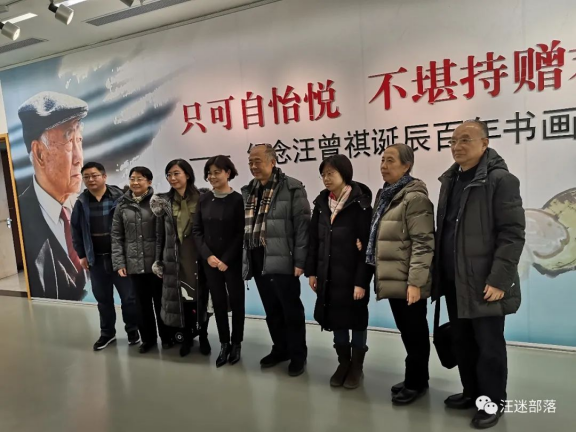
2020., Wang Zengqi100., the year of his birth centenary, also the year of his death23., there were several exhibitions of Wang Zengqi's calligraphy and paintings: Gaoyou, Hangzhou, Guiyang...., the closing work washeld by the“Modern Chinese Literature Museum”., which was divided into“Time·Space”“World·Taste”“Sitting Alone·Gathering”“Spring·Common People”four units. It contains dozens of masterpieces that have not been published in books. From2020.,12.,23., to2021.,2.,28., you can go to see it.
A writer who wants to switch careers to become a painter.
Wang Zengqi could have become a professional painter.
He liked to watch his father painting since childhood. His father, Wang Ju-sheng, had a special studio for painting, and he painted with“four white walls”. He mixed his colors, ground his ink, laid out his paper, smoked, and used his nails to draw the structure on the paper, painted, inscribed, used seals, and then used nails to nail it to the wall, smoking and looking at it for a long time. Wang Zeng-qi was right next to him,“I watched the whole process very carefully, and was very interested in every step.”
1939,19-year-old Wang Zengqi made his way to Kunming to take the college entrance exam. He was aiming for the Chinese department of the Southwest Associated University, but he also made a backup plan, should he not get into the Associated University, he would transfer to the National Art Academy, which was also in Kunming at the time.
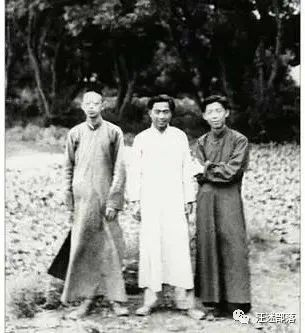
During the period of the Southwest Associated University,with classmate Zhu Dehui(right)Li Rong(left)together
He thought about switching careers completely and starting to paint from scratch after he turned forty,“I have always believed that expressing one's thoughts with brush, ink, and color is more direct and happier.”1987Wang Zengqi recalled in his later years how, as a child, he would make various kinds of plum blossom pearl flowers for the women and elders in his family, and he also vented his frustration with a sentence:“I should have become a craftsman, what the hell is a novel?”
After graduating from university, Wang Zengqi hardly painted any more. In comparison, his calligraphy was somewhat famous. Deng Youmei, a colleague at the Beijing Federation of Literary and Art Circles, recalled that,In the 1950s, the name of the "Sang Xing" editorial department on the envelope was handwritten by Wang Zengqi,"He loved to do this. Three copies each of Yan, O, and Liu styles. Each style of regular script and running script is written in a line, please let the entire editorial department choose democratically. People discuss and evaluate, and there are many who agree, but no one called him a calligrapher because of this. No one asked for his calligraphy."
During his"rightist"downward"relocation to Zhangjiakou, he painted a lot of pictures, the main"of which were two sets of plant"atlases, a set of watercolor paintings of "Chinese Potato Atlas", and a set of pen-and-ink""
Wang Zengqi picked up his brush again,据说 because“the movement”had endless sessions of writing self-explanations, which were really annoying. He could paint a little while taking a break from the explanations, to vent his depression. He once painted a long-billed, big-eyed bird on a piece of paper half the size of a traditional scroll, with one foot curled up, and its white eye looking up to the sky, with the inscription:“Eight Great Mountain Men is not as fierce”. This painting did not survive, but the“long-billed, big-eyed bird”became a certain pattern of Wang Zengqi's paintings of birds.
Wang Zengqi's paintings do not excel in technique. His paintings present a "wildness" that is different from professional painters.“Wildness”. Wang Zengqi's granddaughter, Qi Fang, is a student of the China Academy of Art (formerly known as“National Academy of Art”), and when she returned home from her freshman year, she saw her grandfather's paintings and her first thought was: How can this be different from what the teacher said?
Wang Zengqi's self-evaluation is: "My paintings, as a writer's paintings, are still passable, but to join the ranks of painters would be a cold bath for the artists." "My paintings actually have nothing to offer, but they are just more interesting because they are the paintings of a writer." This is a reminder: when looking at his paintings, the key point lies in "originality".
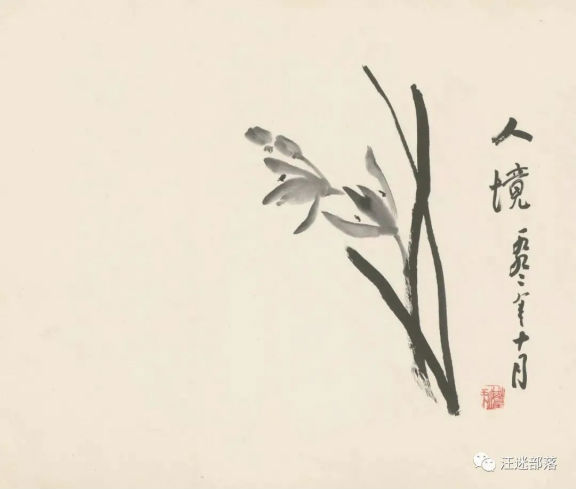
Entering the realm of1992paper-based ink and color
Wang Zengqi painted mostly flowers and birds, occasionally figures, but rarely landscapes——Occasionally a few landscapes can be seen, and the interest is also in the flowers and birds. In Wang Zengqi's paintings, you can't see the complex long scrolls, nor the high and majestic mountains and rivers, but mostly just a flower, a leaf, a bird, etc. However, it is just these seemingly simple small works that can keep people lingering for half a day.
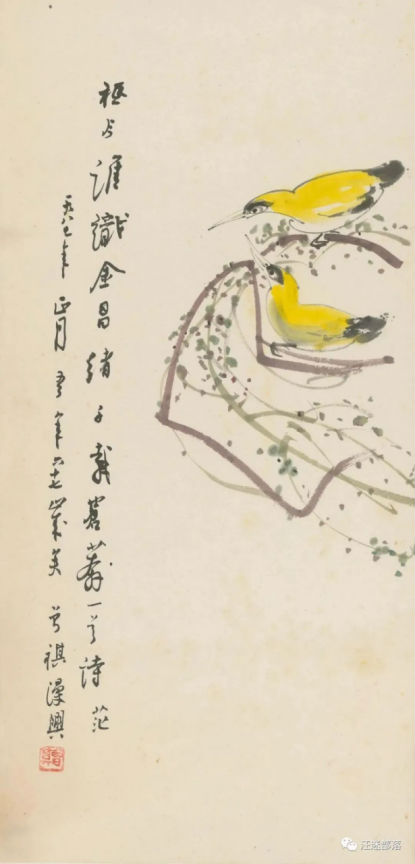
Who knows Jin Changxi,1987year, paper, color ink
Wang Zengqi's standard for choosing subjects is often triggered by a certain object or scene in life, and he quickly gets excited and draws it down. Items such as water chestnuts, lotus roots, bitter melons, and scallions, which are commonly seen in daily life, all appear on his paintings. When looking at Wang Zengqi's paintings, you don't have to "“look up"as if looking at the paintings of a certain master. You just need to look at it levelly, and feel the joy that these small things bring to people, just like Wang Zengqi.
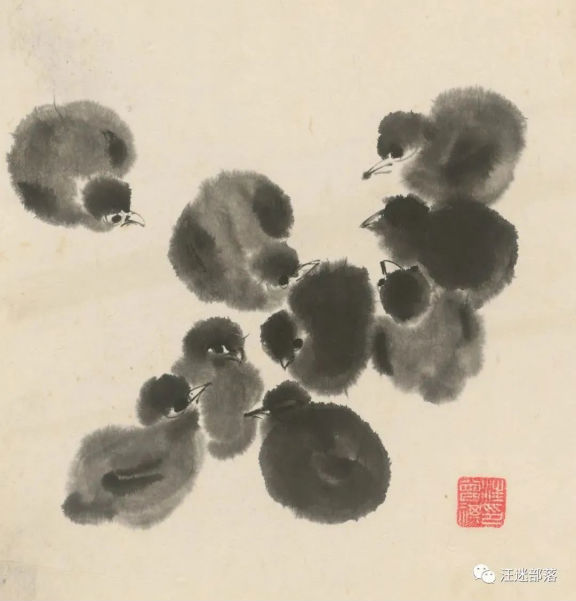
Ink禽, ink on paper
Such as the "Mysterious Chicken" in this century-long calligraphy and painting exhibition, Wang Zengqi uses the depth of ink to show the different feather colors of the chicks, some pure, some mottled, eight chicks curl up together, and another one stretches its neck from afar to explore, lively and cute, which makes people scratch their heads; another example is "The Big Onion and the Mandarin Fish", the viewer will smile uncontrollably when he sees it: most painters paint fish, often painting the fish swimming in the water, and some will even add crisscrossing aquatic plants, but in Wang Zengqi's paintings, a mandarin fish is lying hard there, next to which are chili peppers (small and red螺丝 peppers, which are extremely spicy), big onions and garlic——It is a sign that it is ready to be prepared for the pot immediately.
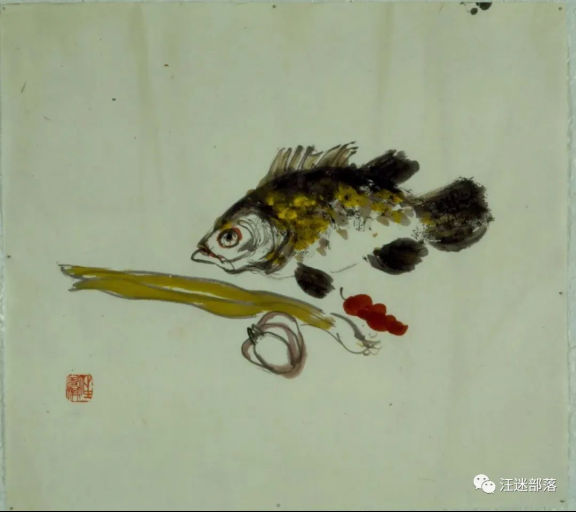
Big scallion and carp painting, ink and color on paper
In Wang Zengqi's paintings, you can always see something different from ordinary painters, a closeness to life, a touch of unforgettable fireworks, which is also what Wang Zengqi intended to show. He once quoted Qi Baishi half-jokingly, "If a painting is too much like it, it is catering to the masses; if it is not like it, it is deceiving the world," and said that he wanted to paint "like" but his skill was not up to it, could it be considered "deceiving the world"? Wang Zengqi's own explanation is: "My paintings, if you say they are good, have a free spirit, and if you say they are not good, they have no fixed rules." In the between, is Wang Zengqi.
Not having received systematic and professional art training, perhaps a regret in Wang Zengqi's heart, allowed him to express his inner thoughts freely, to create paintings with a literary perspective, forming a unique style distinct from professional artists. This result may be summarized by a proverb often quoted by Wang Zengqi:“Dry melon—another taste.”
“Chinese literati painting is freehand”
Wang Zengqi's paintings are typical“ literati paintings ”. The Chinese often say“the source of calligraphy and painting is the same”“the source of calligraphy and painting is connected”, in fact, the functions of ancient books and paintings are not the same. Writing is the basic skill of literati, and the calligraphy of great literati is almost commendable. As for painting, it is not so. After all, the example of a great literati who is also a great painter is rare.
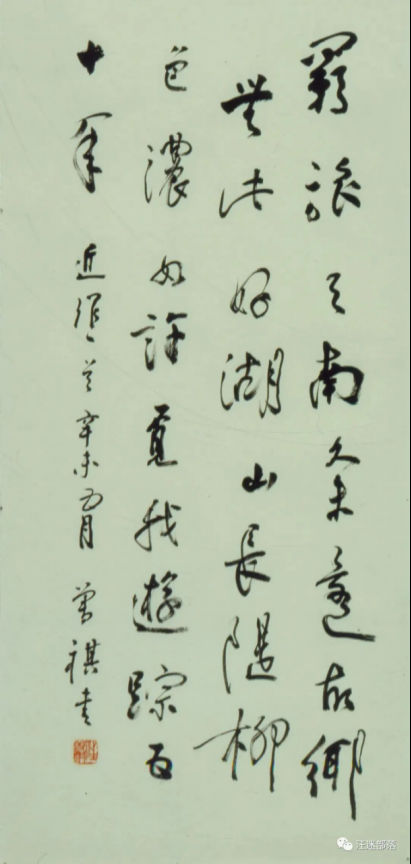
Long in the south, I have not returned,1991Year, ink on paper
“Calligraphy and painting are interlinked”, makes sense only when placed in the context of“ literati painting”. Literati painting emphasizes interest and seeks“the spirit of freedom, without adherence to fixed rules”, as Wang Zengqi put it,“the interest of brush and ink”,“the brush and ink” itself is the goal, and the object is secondary—the pursuit of likeness or unlikeness is not the primary goal of literati painting, whether it can achieve perfect self-expression is the standard to evaluate literati painting.
Wang Zengqi once said that his articles and paintings are interlinked. Articles and paintings are both tools for self-expression for him.“arbitrarily” was how he described the structure of his novels. Later, at Lin Jinglan's invitation, he changed it to “arbitrarily with careful planning”—in fact, this is superfluous. He once quoted Tolstoy's evaluation of Chekhov, saying that like Chekhov, “throwing words around arbitrarily becomes a short story”
Wang Zengqi's attitude towards painting is also close to this. As a literati painting, it emphasizes freehand brushwork, and“freehand brushwork should have a casualness, it should not be too carefully managed, and the painting should not be too rational. When I paint, I have a general conception, and then I start painting with my brush, the ink being thick or thin, is not pre-conceived. The joy of painting Chinese painting is also here”. Wang Zengqi borrowed the poem of Tao Hongjing to evaluate his own paintings as“only for my own pleasure, not good enough to be given to you”. He painted for himself, just“occasionally drank two or three glasses of wine, and on a whim, cut out a piece of rice paper, and painted a few casual strokes”.
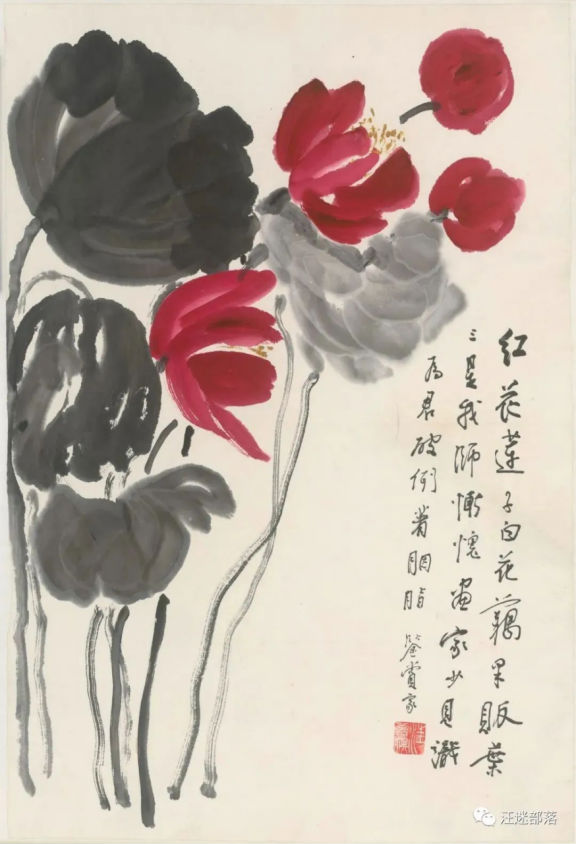
Connoisseur, ink and wash on paper
Different from professional painters, Wang Zengqi's main motivation for painting was“self-entertainment”. According to family memories, Wang Zengqi almost always drank when painting (if he didn't drink, he would not be satisfied with the painting), and after drinking, he painted arbitrarily, with the painting稿 spread all over the floor, leaving no place to step. Wang Zengqi enjoyed a kind of inspiration flooding joy in the process of painting. When he was young, he had a very moving description of this joy:
My eyes open wide, squinting; my chest expands, my abdomen contracts, and I do feel my ankles slimming; I approach, step back a little, walk like a gorilla, strutting with pride; I want to strip off all my clothes and lie flat on the ground. Drunk, I am“like a man in a forest”. My demand for art is that it should give me a high degree of pleasure, a sense of fairyland, a kind of madness: I want to smash it in front of me, turn into a wisp of blue smoke, want to die, want to“have none” left. Such feelings can only be compared with love. (The Artist)
Since it was for his own amusement, Wang Zengqi did not care about the environment or materials for painting, often using ink that had been left overnight to paint, and even when he was out of green paint, he would have a stroke of inspiration and squeeze some spinach juice onto the paper——His children said that these spinach juices have now faded to the point where they are invisible,“organic pigments”are not very effective. This kind of unprepossessing and non-utilitarian creation gave Wang Zengqi the greatest room for play, and only in such a free situation could he paint the talent and emotion that flowed from his heart, and only then could the viewer experience the same kind of joy as in his novels such as "Receiving the戒" and "The Big Ditch"“the joy of the soaring kite and the leaping fish”.
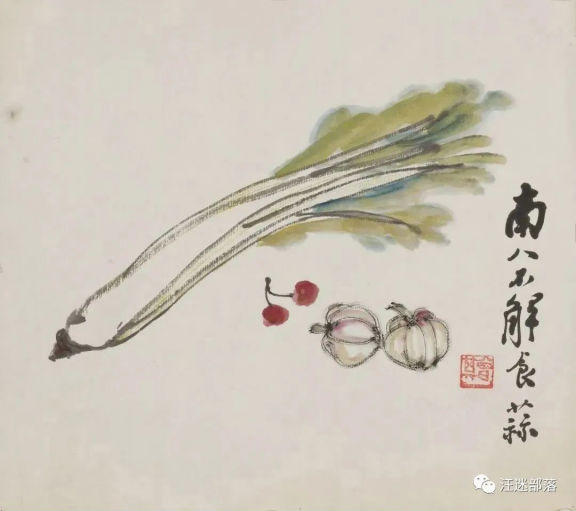
南方 people do not understand eating garlicWang Zengqipaper color
Looking at Wang Zengqi's paintings, it is impossible to separate the painting skills. Wang Zengqi attaches great importance to“title painting”, because“the style of titling paintings began when literati painting and freehand painting became popular”. For this, he specially wrote an article called "Talking About Titling Paintings", praising good titling paintings, such as Zheng Banqiao and Qi Baishi, who can achieve“with aspirations, with interest”, and the position is appropriate, and the characters have rules and styles. In this article, Wang Zengqi, rarely avoiding the criticism of laymen, criticized some bad habits of the current art world:
In recent years, many middle-aged and young painters have been fond of writing poems on Chinese paintings. The paintings are often colorful and messy, and the poems are especially ugly. I don't know why they like to write horizontally at the top of the painting. The content of the poems is very boring, and the characters are like a dancer with a broken leg, unable to even achieve the basic horizontal and vertical lines, almost not worthy of being called characters. Such poems are not art, but ugly art.
Wang Zengqi's own inscriptions on his paintings are very particular and distinctive. For example, in "Planting Chrysanthemums without a Fence", he inscribed"Daughter Wang Ming was there offering advice", which line was her advice? Each viewer may have their own judgment; another example is "What? ", Wang Zengqi painted a red-clad Buddha, with a straight brow and a stare, inscribed"What"two words seem to be the subtitles of a comic strip, which makes people laugh. All these are not worth mentioning, Wang Zengqi's inscriptions are not affected, not pretentious, but entirely the interest of life, a kind of innocent and natural temperament, which complements the paintings and together forms a kind of atmosphere that is worth pondering.
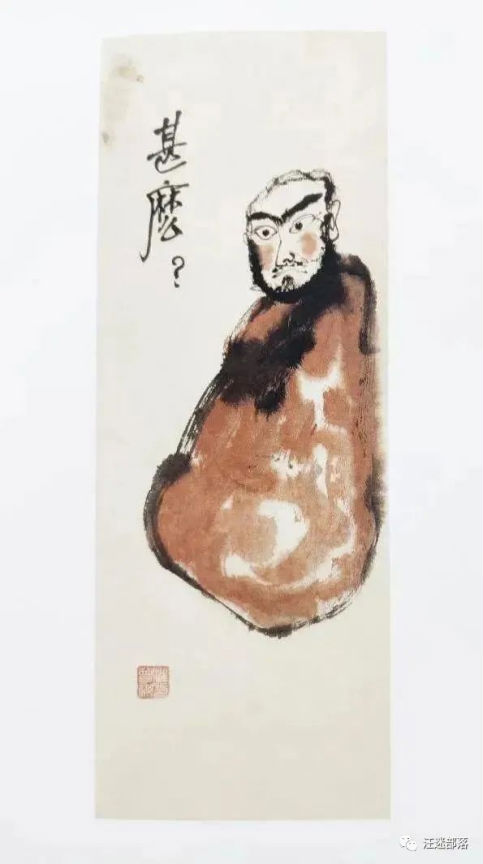
What?
Freedom and freehand, allow Wang Zengqi's paintings to possess a rich and diverse character. Wang Zengqi evaluated his painting style as“neither Chinese nor Western, neither modern nor ancient”. His exploration of painting subjects and painting styles is almost synchronous with his literary exploration, both attempts to“incorporate the foreign into the traditional, blend the extraordinary with the ordinary, and to make the vulgar elegant and the old new”.
He consciously integrated the characteristics of various schools and conducted various bold technical experiments. For example, in the painting "Full Court Moonlight Pear Blossom White", Wang Zengqi tried to use the techniques of Western Impressionism on the basis of ink——In traditional Chinese painting, painting flowers often requires outlining the general contour, even for freehand brushwork, but Wang Zengqi only used colors to embellish instead, with the intention of showing the hazy state of flowers in the night. This work may be able to prove Wang Zengqi's self- description:“I often integrate the methods of late Impressionism into Chinese painting. I think Chinese paintings are all Impressionist, but what I do is more conscious.”
Four Seasons of Good Fun with People
precisely because of his status as a writer, and his“stream of life” style of painting, the correct way to open the“Wang Zengqi Centennial Calligraphy and Painting Exhibition” should not just be to visit the exhibition. A very interesting design of this painting exhibition is that under each painting, there is a piece of Mr. Wang's work, which complements the painting and the text.
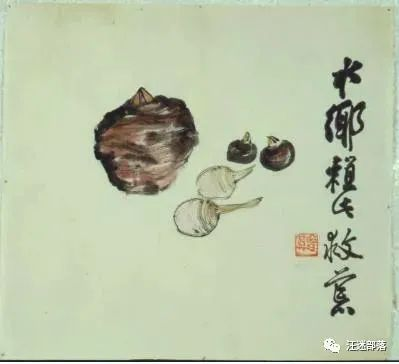
The water town relies on this to save the hungry.
Such as "Lai Ci's Rescue from Famine in the Water Town", Wang Zengqi painted several large and small water chestnuts (also known as water lilies), and wrote the attached text, from "Food of the Homeland":
When I was a child, I really didn't like water chestnuts. This thing has a bitter taste. In the twentyeenth year of the Republic of China, there was a big flood in my hometown, and all the crops were reduced, but only water chestnuts were harvested. That year, I ate a lot of water chestnuts, and I didn't even go to the mouth of the water chestnut, it was really terrible.
I left my hometown at the age of nineteen, wandering around, and I haven't eaten water chestnuts for thirty or forty years, and I don't miss them.
A few years ago, a few days after the Spring Festival, I went to Mr. Shen's home to pay New Year's visits. He invited me to eat, and his wife, Ms. Zhang, stir-fried a dish of meat with water chestnuts. Mr. Shen ate two pieces of water chestnut and said:“This is good!‘the’is higher than a potato.”I admit that he is right. The quality of food is“the”of high or low. This language is precisely Mr. Shen's language. He talks about“the”of everything, including water chestnuts and potatoes.
In contrast, it allows the viewer to more deeply experience the deep concern and compassion that Wang Zengqi had for the flood victims in the water towns when creating this painting. This compassion is not hierarchical, but rather, it breathes and suffers together with them, being simple and sincere. The reason why Mr. Wang is passionate about lotus roots is fundamentally because of his“affection for“““the people”. If we can also combine the novels and essays such as "The Doctor who Fishes" and "The Wild Vegetables of My Hometown", we can more deeply read the "
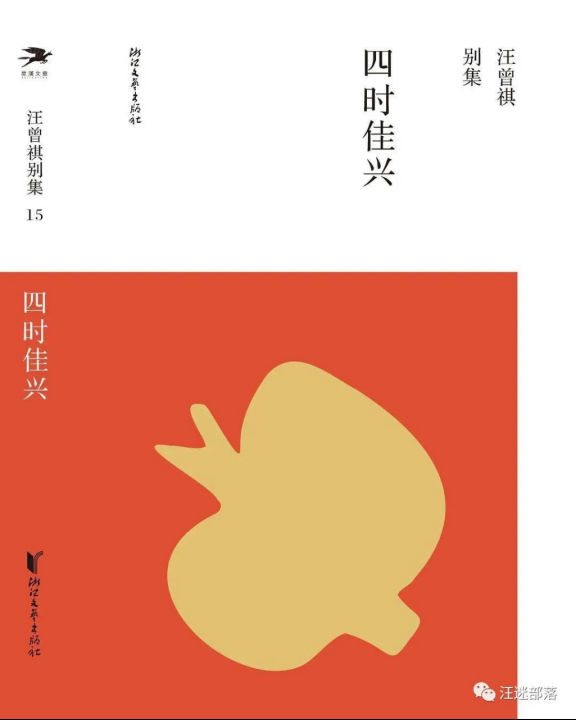
Wang Zengqi particularly appreciated“Four Seasons of Fine Excitement”four characters, which he used several times as column names, painting titles, and the source of a poem by the Song Dynasty Confucianist Cheng Yi“Everything is calm and content, and the joy of the four seasons is the same as that of human beings”. Wang Zengqi regarded this poem together with“Suddenly feel that there is life in front of me, but you must know that there are many苦 people in the world”as his“attitude towards life and creation”. If paintings such as "Water Township Lei Ci Saving Famine" represent the“but you must know that there are many苦 people in the world”of compassion for the world, "Four Seasons of Fine Excitement is with people”can better reflect Wang Zengqi's“Send a little warmth to the world”of light and warmth,“what I paint is mostly‘Spring’——the joy of life. I paint flowers and birds. The flowers I paint are all ordinary flowers. The people of Beijing call such flowers‘weeds’.”(“Self-Entertainment of Calligraphy and Painting”
To understand this level, it is not enough to just look at the painting.
With the opening of the calligraphy and painting exhibition, the 20-volume "Wang Zengqi's Complete Works", published by Zhejiang Literature and Art Publishing House, is unveiled. The biggest feature of this complete works is the "mixed compilation", which includes letters, essays, novels, interviews, and even confessions, all stuffed into one volume. The intention is to allow readers to have a comprehensive understanding of Wang Zengqi's behavior, writing style, and temperament in a certain aspect.
Two volumes of Prose, "Four Seasons of Fine Excitement" and "Plants, Insects, Fish, Birds and Beasts", were edited by Qi Fang, the granddaughter of Wang Zengqi who studied art, and can be read in conjunction with his paintings and calligraphy. They contain literary and artistic theories, prefaces and postscripts, and short essays, and Wang Zengqi's artistic sense flows like water between the lines.
But the most interesting, however, is the three letters to Wang Huan and Song Aiping.
Wang Huan and Song Aiping are husband and wife, both oral科 doctors. Wang Huan likes literature,1984he once wrote a letter to Wang Zengqi to ask about creative issues. Wang Zengqi has been troubled by dental diseases since college, Wang Huan introduced him to the Beijing Construction Worker Hospital where Song Aiping works to see a dentist, and also made a set of dentures for him. Wang Zengqi would send them a copy of his book whenever he published one.
Two years later, Wang Huan and Song Aiping had a son, and they asked Wang Zengqi to name him. Wang Zengqi replied with four names, one of which was“Wang Xuan”. He explained that“Xuan is the same as day Lily. The ancients believed that the day Lily could help forget worries. The shape of this character is not ugly, and the sound is also pleasant.”He also mentioned that his son Wang Lang said“Xuan”looks like a woman's name, and the old man was not convinced. He said that the famous painter of the Tang Dynasty, Zhang Xuan, was male. Therefore, they used“Wang Xuan”.
1990 year, Wang Xuan's fourth birthday came, and Wang Zengqi actually painted a set of books (12 pieces) for the family of three, and it was his masterpiece:“This set of books can represent my painting style and skill at the age of seventy.”I have never heard of any leader or writer being treated in this way. It is estimated that he knew that the young couple were ignorant of calligraphy and painting, and Wang Zengqi also wrote in detail in the letter about the strategy of mounting:
How to mount, you can consult the mounter. I think it is better to mount it as a single page (of the same size). Do not mount it as a long strip of connected pages. Single pages can be separated and combined. You can look at one page alone, or you can look at several pages together. Since the painting is large, do not add a very wide silk edge. The silk edge of each painting should be unified in one color, do not use different colors for each painting. Leave two blank pages, you can mount one or two blank pages to invite someone to write a comment.
The cutest one, Wang Tiesheng added:“It will cost a lot to frame this album. Better not frame it, it won't affect Wang Xuan eating ice cream.”Eating ice cream is a big thing in Wang Zengqi's eyes. What about the album? It contains Wang Zengqi's attitude towards himself, others, further, towards life and society. Wang Lang once summarized it as“Do things seriously, treat people equally”eight words, which is fully revealed here.
This is the story behind the painting. But it is indispensable material for understanding the painter Wang Zengqi.
Author|Yang ZaoWang PM

TodayRecomBook
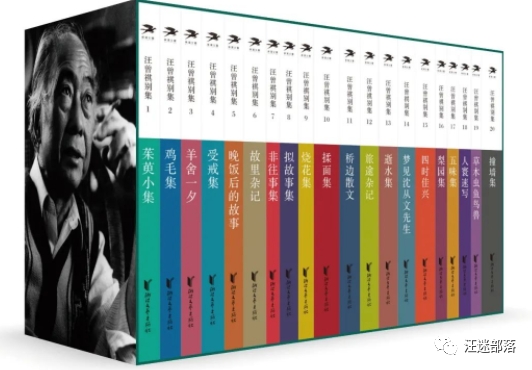
The Complete Works of Wang Zengqi20
Click on the original text in the lower left corner, purchase from【My We店】
The illustrations, text, and audio in this article that do not have an indicated author.
Please have the author contact WeChat君 to add a note.