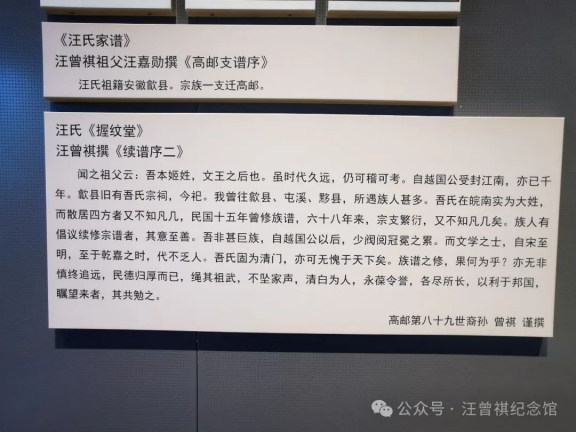
2024Year5May16day, Jiangsu Provincial Party Secretary Xin Changxing came to Wang Zengqi Memorial to inspect the work, and lingered for a while at the "Home Lineage" exhibition section of the memorial. Wang's "Gou Wen Hall", Wang Zengqi's "Continuation of the Genealogy Preface Two" records:“I am originally of the Ji family, a descendent of King Wen.”
“Xin”and“Wang”surnames, both originated from“Ji”surname.“Xin”is derived from Xinling Jun, the son of Wei Zhao Wang, Wu Ji, surname“Ji”. It was named after his fiefdom located in Xinling (present-day Ningling, Henan) during the Eastern Han Dynasty, as recorded in the Xin“character from his title as their surname, forming the”Xin“, a branch of the descendants of Xinling Jun took theXingzizhang·Shuowen Jiezi
According to "The Story of the封神演义", King Wen of the Western Zhou Dynasty had100sons. Historically verifiable, there were18of them. The eldest son, Bo Yi Kao, the second son, Ji Fa, the third son, Guan Shu Xian (Ji Xian), and the fourth son, Duke of Zhou, Dan (Ji Dan). Ji Dan's eldest son was enfeoffed as the ruler of the Lu State in Shandong, the thirteenth-generation descendant of Duke Bo Qi, the son of Ji Heng, the second son of Duke of Zhou. During the Spring and Autumn Period, he was awarded the title of Marquis of Shang (Yingchuan Marquis), with the fief of Yingchuan (an ancient county name located in today's Yuzhou City, Henan Province. The hometown of Dayu, the capital of the Xia Dynasty). At birth, he had his hands clenched into fists, which did not open for three days. After stretching, there were patterns on both palms, with water on the left and a king on the right, combined into"Wang". Thus, he was named Wang. Yingchuan Marquis had a son, Ting, who had two sons, Song and Mang. The eldest son, Song Gong Jue, named after the auspicious meaning of the name of his ancestors, thus respected Yingchuan Marquis as the founder of the Wang family, and called himself the third-generation ancestor. From then on, a great surname was born on the land of China-Wang Family.
According to Wang's Ancestral Records——Wang Hua's "New Anhui Famous Ethnic Group" records“The Wang family began with the second son of the Marquis of Yingchuan, Lu Cheng Gong Hei Geng, who was born to Lady Si. He had a mark on his hand that said Wang, so he named it. Later, he made contributions to Lu and was awarded a fief in Yingchuan, known as Wang Marquis. His descendants then took it as their surname. The place in Pingyang, Wang's hometown.”This is the origin of“Gou Wen Tang”.
The founding ancestor of the Wang family in Huizhou was Wang Wenhao during the reign of Emperor Ling of the Han Dynasty,“He was awarded the title of General of the Dragon's Shoulder for his achievements in defeating the Yellow Turban Rebellion. In the second year of Jian'an, due to the great chaos in the Central Plains, he crossed the Yangtze River to the south. Sun Ce recommended him to be the governor of Jimanding (present-day Shaoxing), and he settled down in She.”
Wang Hua was the 44th descendant of Wang Hou.He was born in the year of the Ming Dynasty, the fourth year of the reign of Emperor Zhidao of the Chen Dynasty (AD 586) on the eighteenth day of the first month, and died in the twenty-third year of the reign of Emperor Zhen Guan of the Tang Dynasty (AD 649) on the third day of the third month, at the age of sixty-four. At the end of the Sui Dynasty, the government was in disorder and the world was in chaos. Wang Hua rose up and established a割据 regime in Jiangnan, Shexian, Xuancheng, Hangzhou, Muzhou, Wuzhou, and Raou, protecting the peace of the six states."He ordered the prefect of Xuancheng, Tiefo, to present a tribute of submission in the fourth year of Wude (AD 621) in September, and was immediately appointed as the governor of Shexian, Xuancheng, Hangzhou, Muzhou, Wuzhou, and Raou, and was awarded the title of Wei Guo Gong. He was later respected and posthumously honored by the imperial family.Song Dynasty, which lasted for more than three hundred years, awarded Wang Hua10times. In the fourth year of Hongwu in the Ming Dynasty (AD 1371), Zhu Yuanzhang"the great and correct ritual","ordered""all temples dedicated to the gods of darkness and debauchery to be closed. The only temples left in Anhui were those of Wei Guo Gong and Chen General Cheng Zhongzhuang. The god of Wei Guo Gong was renamed the God of Tang Yue, and it was ordered that the relevant departments should offer sacrifices to him in spring and autumn."He enjoyed the national ritual. The title written on the statue of Wang Hua in the Wang Wang Temple on Wushan in Hangzhou:"Li Xiang An Zhao Zhong Xiao Wen Wu Li Ling Xian Wang Tang Yue Guo Gong.He was worshipped as the"God of the Land"in the area of Anhui.
Wang Hua had nine sons, according to the local scholar, the original chairman of the Gao Yang Political Consultative Conference, the director of the Gao Yang Cultural Research Institute, and the vice president of the Jiangsu Province Stamp Association, Ni Wen Cai: The Gao Yang Wang Guangyang branch is the seventh son of Wang Hua, and the descendants of Wang Shuang.73Wang Guan Shi, who was originally from Xunning, Anhui, moved to Gao Yang, and he was the grandfather of Wang Guangyang, belonging to the Wang Shuang's family. Wang Guangyang was a prime minister and a minister in the early Ming Dynasty. Wang Hua's eldest son Wang Jian's descendants.81Wang Qi Feng, who was the ancestor of Wang Zengqi (89), moved to Gao Yang from the ninth generation above Wang Zengqi.
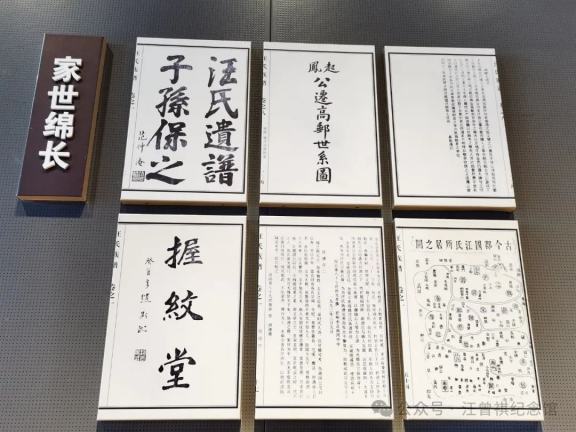
The exhibition at Wang Zengqi Memorial Hall, "Home Lineage," features a picture of Fan Zhongyan's inscription for the Wang family genealogy:“The Wang family's ancestral records, preserved by the descendants”. Visitors often ask curiously,“What is the connection between Fan Zhongyan and the Wang family clan?”I checked the relevant information, and it turns out that Fan Zhongyan wrote the inscription for Wang Xie, who once studied under Hu Ai, a distinguished student of Hu Ai. Hu Ai, from Taizhou, was a scholar, a pioneer of Neo-Confucianism, a thinker, and an educator of the Northern Song Dynasty. Later, he retired to his hometown and founded“Anding Academy”. Fan Zhongyan, on the other hand, established county schools in Suzhou and Huzhou, and hired Hu Ai to teach in Suzhou and Huzhou.
Wang Xie, style name Zhongrong. He was a graduate of the imperial examination in the eighth year of Xining in the Northern Song Dynasty (1076). He was from Xinjian Village, Jingde County (Xuancheng). He was born into a poor family, and his ancestors had not held official positions for three generations. He was admitted to the Imperial College as a "”Commoner”. He had no direct connection with Wang Hua in time and space, and was a branch of the Wang family. He served as a divisional official, academician, director of the Imperial College, and provost (similar to a principal), and later served as the great master of the college (the supervisor of the Imperial College). He spent most of his life in education. Until his old age, he was still diligent in writing. He participated in the compilation of Wang Anshi's "Three Classics New Meaning". His level of poetry is very high, and his poem on the Gui Zi Pavilion in the Qing Dynasty's "Jingde County Annals" is recorded:”影浮明月高群木, 香袭华亭瞰好山.”The annals record that his writing is”Speech is wonderful in the world, warm and gentle, profound and extensive, a piece of work that everyone competes to recite,”which has outstanding achievements in the history of ancient Chinese academic thought.
Wang Zengqi wrote in "Second Preface to the Continuation of the Genealogy": Why is the genealogy compiled? It is nothing more than to respect the ancestors and return the people's morality to the past, to follow the example of the ancestors, not to fall into the family reputation, to be an honest person, to protect the good reputation forever, to use one's own strengths, to benefit the country, to entrust the future, and to encourage everyone to work together.”