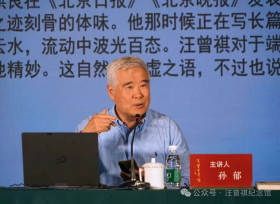
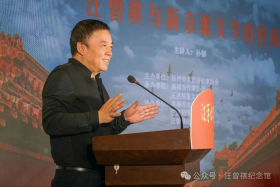
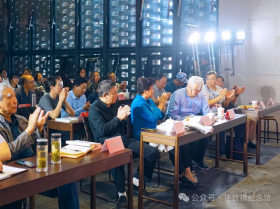
This year marks the105thanniversary of the birth of Mr. Wang Zengqi. In the related commemorative activities,评论家 Wang Gan commented that“the era of Wang studies has arrived”,which has attracted widespread attention from various media. This afternoon,“Wang Studies Open Course”was delivered at the Wang Zengqi Memorial Hall in Gaoyou City, with the first speaker being Professor Sun Yu, a scholar, Lu Xun research expert, and Wang Zengqi research expert. He has served as the director of the Lu Xun Museum, the dean of the School of Literature at Renmin University of China, the president of the Chinese Lu Xun Research Association, the deputy director of the散文委员会 of the Chinese Writers' Association, and a distinguished professor of the Yangtze River Scholar Program. He has published more than thirty academic works and literary works, and the content of his lecture is “Wang Zengqi and the Formation of the New Beijing School Literature”.Reporters have transcribed the text from the recording to present to readers.
The Beijing School echoed the new Kantian trend.
The characteristics of the Beijing School is the unity of aesthetic modernity and enlightenment modernity, which caters to the trend of new enlightenment in the 1980s. In fact, Li Zehou's study of Kant corrected Hegel's essentialism and brought the issue of subjectivity into the intellectual circle. In terms of aesthetics, the re-discovery of Fei Ming and Shen Congwen coincides with this trend. Fundamentally speaking, the literature of the Beijing School belongs to the tradition of neokantianism, which reveals the fate of human beings and social issues in folk and language, and supplements Li Zehou's theory of subjectivity. The formulation of Liu Zaiyu's literary subjectivity integrates the spiritual elements of humanism since the May Fourth Movement, and its aesthetic judgment is similar to Zhu Guangqian, Shen Congwen and Lin Huiyin. The emergence of the new enlightenment in the 1980s is a connection in the historical chain, or, the left-wing spirit and the new Beijing School thought are no longer two opposite sides, and their intersection has become the growth point of aesthetic.
An interesting phenomenon is that the emergence of the New Beijing School in the 1980s and 1990s has promoted the study of the Beijing School literature. The representative figures in the academic circles include Zhang Zhongxian, Xu Fangqing, Su Wu, Chen Pingyuan, Zhi Yan, etc. The representatives in the literary circles include Wang Zengqi, Duan Mu Heng, Zong Pu, and a large number of people. Zhang Zhongxian's book "The Theory of Life哲学" many from“The House of Hard Rain”主人,他的大量著作在延续周作人的学术思想。徐梵澄的古典学理念,打破了普通的学科界限,显得比“The House of Hard Rain”群落更有气象。
Wang Zengqi and his peers
In the time of Wang Zengqi, there were also some people who walked with him.
Du Mu Hongliang, in his writing since the 1990s, has attracted attention. Wang Zengqi has a high opinion of Du Mu Hongliang, thinking that his writing is more exquisite than his. This is, of course, a modest word, but it also shows the position of Du Mu Hongliang in the hearts of Beijing writers at that time. However, among the New Beijing School writers, Du Mu Hongliang's influence has never been as good as Wang Zengqi's. Du Mu Hongliang did not return to the daily life, but walked into the mysterious and unattainable mountain road. And Wang Zengqi is still in the worldly fireworks, in the market and the wild, to produce the kind of fairy spirit of Su Shi, and the distance between him and the readers is close. The charm of Wang Zengqi's prose is influenced by Mr. Du, such as the articles recalling the characters, which are good at starting from details, and revealing knowledge in the plain. Wang Zengqi likes it very much. We see him talk about Shen Congwen and Jin Yue Lin, and also use a similar narrative style. But Mr. Du's articles still retain some concepts in the current style, and Wang Zengqi does not, completely pure, and appears to be more pure. Therefore, Du Mu Hongliang is lonely after his death, and Wang Zengqi is popular all over the country.
There is also Zong Pu, who was also influenced by the left wing in the past. Zong Pu's writing after the 1980s and 1990s has a spiritual leap beyond the barriers of the early spirit. The experience of her father's Southwest Associated University and her own experiences and feelings have allowed her to connect with a more diverse ideological tradition. Her novels have more of a sense of time and history than the old-style Jing Pai school, while her spiritual interests leave traces similar to those of Fei Ming and Wang Zengqi. The long series of novels "The Wild Gourd Leading" continues the ancient heritage of the capital's literati, but the side of being concerned about the world and the country is also clearly visible.·The writing of "The Wild Gourd Leading" is full of twists and turns, and the忧患之音 flows through, showing a kind of sentiment of the intellectual class.
There is also Zhang Zhongxian, who in his later years, Zhang Zhongxian has been silently promoting the academic ideas of Peking University. In summarizing the tradition since the May Fourth Movement, he treats Lu Xun's spirit and Hu Shi's tradition equally, and the texts describing Zhou Zu-ren, Qian Xuan-tong, Liu Ban-nong, and Fei Ming also have a strong theoretical support. Zhang Zhongxian is both a writer and a researcher of the Beijing School. He believes that among the writers of the Republic of China,“Ku Yu Zhai”is a tradition that should not be overlooked. The fate of the ancient capital literati shown in "Fu Xuan Suo Hua" and "Fu Xuan Xu Hua" reminds people of ancient notes, and some people read the flavor of "Shi Shuo Xin Yu" in it, which is also reasonable. Zhang Zhongxian's knowledge system is not Russian or Soviet. Philosophically, he likes Kant and Russell. In poetry and prose, he is between the Six Dynasties and Song and Ming. He also has insights into the ancient Greek research and folk research of his teacher Zhou Zu-ren. The tradition of Peking University is, on the one hand, to study the relationship between heaven and man on the level of epistemology, and on the other hand, to follow the individual on the level of aesthetics, to gaze into the depths of the heart.
Compared to Zhang Zhongxian's nostalgia, Wang Zengqi's reference to the "Ku Yu Zhai" resources is more significant. One is the inheritance of the concept of prose, with many insights into the concept of prose in the Six Dynasties and the late Ming Dynasty. The repeated advocacy of the new style of prose, which is a blend of classical and vernacular Chinese, is the concept insisted by Fei Ming and Yu Pingbo; the second is the emphasis on folklore, the description of dialects, customs, and beliefs between novels and essays, presenting a rich picture of human life. This seems to echo the legacy of the folk song survey; the third is the emphasis on child psychology, reflecting the beauty of childlike innocence in customs. The meaningless meaning in the game is a rare element in the Chinese scholar-bureaucrat literature, and these are a kind of resolution to the utilitarian literature; the fourth is the re- recognition of the value of non-standard Confucianism, affirming the original Confucianism's robust and peaceful style from a higher level. In the complex culture, no longer choosing the extreme trend of thought, but expressing the inner peace and beauty with a moderate voice. These four levels of spiritual borrowing not only re-examine the tradition of the Beijing School during the Republic of China but also become a panacea for the new Beijing School writers to overcome their spiritual diseases. The writing of the new Beijing School writers deepens the understanding of the "Ku Yu Zhai" tradition, and those sleeping inspirations are re-summoned in the realistic worries of the present generation.
Zhang Zhongxian was quite popular in the 1990s, but he is not as famous as Wang Zengqi after his death. This may be because his boundaries are too distinct, sticking to“Ku Yu Zhai” tradition, and his thoughts follow the spirit of Russell and Kant. He holds a critical attitude towards the radical culture.
Compared with Zhang Zhongxian, Wang Zengqi is slightly inferior in knowledge, but he does not draw lines in his concepts. He can look at various schools and adopt their good parts. The former is fond of simple Confucianism, while the latter focuses on Western philosophy and Buddhism, with "The Theory of Living by Nature" and "Buddhism and Literature" published.
Why was Wang Zengqi able to become the representative figure of the new Beijing school?
First of all, Wang Zengqi broke away from the ivory tower spirit of the old Peking school. Wang Zengqi is different from Nan Xing, who admires Baline, Lu Xasi, and Lawrence, probably due to the unsuitability of aesthetics. They are placed in modern society, but their expression is the heresy of modern society. Nan Xing's works lack the泥土 and urban flavor, which limits the breadth and depth of his aesthetics. Wang Zengqi, in the old-style scenery, has mixed in the colors of the vast people's life. The scenery in his old streets and markets is alive.
Moreover, Wang Zengqi turned the elite into folk. Look at Zhou Zuó's writing about“Eating Tea”:“In ancient China, people used to drink fried tea and matcha, but now we use brewed tea. Okakura Tensho ingeniously called it natural tea in his book "The Book of Tea", so what we value is this natural flavor. Chinese people go to tea houses, drink bowls of tea on the left and right for half a day, looking as if they had just walked out of the desert, which is quite in line with my meaning of drinking tea, but unfortunately, it has become too much like a Western restaurant recently, losing its original intention, and the result is that it has become a restaurant of the same kind. Only in the countryside is there still a bit of ancient custom, but the houses and utensils are so simple that it can only be said that they have a certain meaning of drinking tea, but not that they have already mastered the way of drinking tea.”
Wang Zengqi wrote“Eating Tea”:“Gong Ding'ang thought that the Biluochun was the best in the world. I once drank a new batch of Biluochun at the Carving Pavilion in Dongshan, Suzhou. The Carving Pavilion was originally a residence of a wealthy overseas Chinese, made of imported hard wood, with carvings everywhere, such as the Eight Immortals, Fu Lu Shou, dragons, phoenixes, peoniesIt really is a collection of the worst tastes. But Biluochun really is good. However, the tea was brewed in a big bowl, which I think is a bit spoiling the scenery. Later, I asked Lu Wenfu, who said that Biluochun is all about drinking in big bowls. The tea is very fine, the utensils are very coarse, it's strange! I also drank a vezha tea in Taoyuan, Hunan. Tea, old ginger, sesame, rice, with salt, are put in a pestle, and are ground into a fine powder with a hard wood pestle, and then poured with boiling water, and that's vezha tea. Tea can be used as food, and can be made into food. There is Longjing shrimp in Hangzhou, which is not bad. Qiu Shengrong once used Longjing tea to make dumplings, which can be said to be unique. Japan has tea porridge. The "Haiku's Cookbook" says that when haiku poets get together, the food is very simple, but tea porridge is one item that must not be missing.”
Compared to this, Wang Zengqi's writing is very popular and folk-like.
Wang Zengqi's writing has a avant-garde spirit, mainly due to the description of the absurdity of life. For example, the awkwardness of personal creeds in life in "Eight Thousand Years", “General does not guarantee”“Monks and Taoists have no connection”the concept of the shattering; and also the root of the son's misfortune in "Kuan Gong", which is the result of the father's life habits, Kuan Gong's usual debauchery, which is the basis of social tragedy.
Wang Zengqi also has Confucian-style individualism. Wang Zengqi wrote in "I am a Chinese-My Creative Career:“One critic said that the tranquil and natural life attitude of some of the characters I wrote has traces of Laozi and Zhuangzi, and inferred that I personally also appreciate Laozi and Zhuangzi. When I was young, I did indeed read "Zhuangzi". But after reflecting on myself, I still accepted more Confucian influence. I think Confucius is a very humanistic thinker and also a poet. I very much appreciate Zeng Qian's ambition‘in the late spring, when the spring clothes are ready, several adults and six or seven children, bathe in the Yi River, blow the wind in the dance, and sing and return’. I think this is a transcendent, beautiful, and poetic life attitude. I appreciate such a poem by Song Confucian:‘Everything is self- content when viewed in silence, and the same joy in the four seasons is shared by all’;‘all of a sudden, I feel that there is a fullness of life in front of me, but I must know that there are many苦 people in the world’. I am a Chinese-style, lyrical humanist.”In the May Fourth New Literature, Confucianism and individualism are in opposition. But Wang Zengqi found a balance between the two.
Wang Zengqi's writing provides phenomonological specimens for description rather than explanation. Wang Zengqi once wrote in "The Man Who Sells Earthworms"“I am a writer of short stories. For a person, I only want to understand, appreciate, and depict him. I do not want to make any judgments about anyone. Like one of my teachers, what I am fond of in this world is phenomena. I am not good at abstract thinking. I pay more attention to the aesthetic significance of a person.”
A consummate novelist or narrator of modern times is fully aware of his limitations, rooted in a reality field that his intelligence can never exhaust, piercing the glass dome of self-deception, and awakening or identifying the world that he carries within himself with a language that follows its own internal rhythm and acts on its own. Possessing the ability to transform and adjust everything he knows at any moment. The modern novelist experiences everything he experiences, and with his complete imagination, which reaches a certain limit, he weaves or arranges the fragmented, accidental, and chaotic daily life into an orderly“single experience”, allowing the narrative to take place within a complete world, endowing the characters with a powerful life, and extracting the eternal from the stream of ordinary life, pointing towards something that is worthy of awe and is higher than himself.
 Source: Yangzhou News
今年是汪曾祺先生诞辰105周年,在相关的纪念活动中,著名评论家王干,提出“汪学时代已经到来”的论断,引起各大媒体的广泛关注。今天下午,“汪学公开课”第一讲在高邮市汪曾祺纪念馆开讲,首讲人为著名学者、鲁迅研究专家、汪曾祺研究专家孙郁教授。他曾任鲁迅博物馆馆长、中国人民大学文学院院长、中国鲁迅研究学会会长、中国作家协会散文委员会副主任、长江学者特聘教授。出版学术著作与文学作品三十余部,他的讲课内容为《汪曾祺与新京派文学的形成》。记者根据录音整理文字稿件,以飨读者。
The New Beijing School echoes the New Kantianism movement
The characteristic of the Beijing School is the unity of aesthetic modernity and enlightenment modernity, which caters to the new enlightenment trend of the 1980s. In fact, Li Zehou's study of Kant corrected Hegel's essentialist thinking and introduced the issue of subjectivity into the intellectual realm. In terms of aesthetics, rediscovering Fei Ming and Shen Congwen aligns with this trend of thought. Fundamentally speaking, Beijing style literature belongs to the tradition of Neo Kantianism, which reveals human fate and social issues in terms of folk customs and language, supplementing Li Zehou's theory of subjectivity. Liu Zaifu's expression of literary subjectivity integrates the spiritual elements of humanism since the May Fourth Movement, and his aesthetic judgment is similar to that of Zhu Guangqian, Shen Congwen, and Lin Huiyin. The emergence of the New Enlightenment in the 1980s was a connection in the historical chain, or in other words, the left-wing spirit and the New Beijing school of thought are no longer two opposing sides, and their intersection has become an aesthetic growth point.
An interesting phenomenon is that the emergence of the New Beijing School in the 1980s and 1990s promoted the study of Beijing School literature. Representative figures in the academic community include Zhang Zhongxing, Xu Fancheng, Shu Wu, Chen Pingyuan, and Zhi An. The representatives of the literary world are a large number of people such as Wang Zengqi, Duanmu Hongliang, and Zong Pu. Many of Zhang Zhongxing's understanding of the philosophy of life in his book "Shunsheng Lun" came from the owner of the "Ku Yu Zhai", and his extensive writings continue the academic ideas of Zhou Zuoren. Xu Fancheng's classical learning philosophy breaks the general disciplinary boundaries and appears more atmospheric than the "Ku Yu Zhai" community.
Wang Zengqi and his contemporaries
In the era of Wang Zengqi, there were still some people who accompanied him.
Duanmu Hongliang's achievements in writing since the 1990s have attracted attention. Wang Zengqi greatly admires Duanmu Hongliang, thinking that his writing is not as exquisite as his. This is naturally a humble language, but it also indicates the position of Duanmu Hongliang in the minds of Beijing writers at that time. However, among the writers of the New Beijing School, Duanmu Hongliang's influence has never been as significant as Wang Zengqi's. Duanmu Hongliang did not return to daily life, but walked into mysterious and unattainable mountain roads. Wang Zengqi, on the other hand, is still immersed in the hustle and bustle of the world, exuding a Su Shi style fairy aura in the marketplace and wilderness, and getting closer to readers. The charm of Wang Zengqi's prose is influenced by Mr. Duanmu. For example, in his articles recalling characters, he is good at starting from details and revealing knowledge in plain places. Wang Zengqi quite likes it. We see that he used a similar narrative style when talking about Shen Congwen and Jin Yuelin. But Mr. Duanmu's article still retains some concepts from the current trend, while Wang Zengqi does not, it is completely clear and pure, appearing even more pure. So, Duanmu Hongliang felt lonely behind him, while Wang Zengqi became popular throughout the country.
There is also Zong Pu, who was once influenced by the left wing. In her writing after the 1980s and 1990s, Zong Pu's spirit transcended the barriers of early spirit. The experience of her parents' Southwest Associated University and her own personal feelings enabled her to connect with more diverse ideological traditions. His novels have added a sense of the times and history that the old Beijing style did not have, while his spiritual taste has traces of being useless and similar to Wang Zengqi. The novel series "Wild Goulu Yin" continues the ancient legacy of literati in the imperial capital, but the side of feeling anxious about the country is also vividly visible. The "Record of Southward Journey", "Record of Eastern Tibet", "Record of Western Expedition", and "Record of North Return: Introduction to Wild Gourds and Lues" are written with a hundred twists and turns, and a thousand clouds and a dark moon. The refined and elegant spirit of ancient culture lingers among them, while the sound of worry flows, revealing a kind of sentiment among intellectuals.
There is also Zhang Zhongxing, who in his later years silently devoted himself to popularizing the academic ideas of Peking University. When summarizing the traditions since the May Fourth Movement, he treated the spirit of Lu Xun and the tradition of Hu Shi equally, and the texts describing Zhou Zuoren, Qian Xuantong, Liu Bannong, and Fei Ming also had deep theoretical support. Zhang Zhongxing is both a writer and a researcher of the Beijing School. He believed that among the writers of the Republic of China, the "Ku Yu Zhai" community was a tradition that should not be ignored. The fate of ancient Chinese literati depicted in "Negative Xuan's Essays" and "Negative Xuan's Continuation" reminds people of ancient notes, and it is reasonable for some to read the flavor of "New Tales of the World" from them. Zhang Zhongxing's knowledge lineage is not from Russia or the Soviet Union. Philosophically, he likes Kant and Russell, and his poetry and prose are between the Six Dynasties and the Song and Ming dynasties. He also has insights into his teacher Zhou Zuoren's research on ancient Greece and folk customs. For him, the tradition of Peking University is twofold: firstly, in terms of epistemology, he can explore the universe, while in terms of aesthetics, he follows individuality and gazes into the depths of his heart.
Compared to Zhang Zhongxing's nostalgic mood, Wang Zengqi's borrowing of resources from the "Ku Yu Zhai" is significant. One is the inheritance of the concept of writing, and there are many insights on the concept of writing in the Six Dynasties and Late Ming Dynasty. The repeated promotion of a new literary style with alternating text and white is precisely the concept upheld by Fei Ming, Yu Pingbo, and others; The second is the emphasis on folklore studies, where the descriptions of dialects, customs, and beliefs between novels and essays present a rich picture of the human world. This seems to echo the legacy of the folk song investigation back then; The third is the emphasis on children's education, reflecting the beauty of childlike innocence in customs. The meaningless meaning in games is a scarce element in Chinese literati literature, which is a kind of dissolution for utilitarian literature; The fourth is to re recognize the value of non authentic Confucianism and affirm the vigorous and peaceful style of primitive Confucianism from a higher level. In complex cultures, we no longer choose extremist ideologies, but express the beauty of inner peace through the voice of neutrality. These four levels of spiritual borrowing not only allowed for a re examination of the traditions of the Beijing School during the Republic of China period, but also became an important remedy for new Beijing School writers to overcome their mental illnesses. The writing of the New Beijing School writers deepened the understanding of the traditional "Ku Yu Zhai", and those dormant spiritual thoughts were summoned back in the current reality and difficulties.
Although Zhang Zhongxing was quite popular in the 1990s, he was not as famous as Wang Zengqi. This may be due to his overly clear boundaries, adhering to the tradition of "bitter rain chamber" and following the spirit of Russell and Kant in his thinking. Take a critical attitude towards radical culture.
Compared to Zhang Zhongxing, Wang Zengqi's knowledge is slightly inferior, and he does not draw a line in his ideas. He is able to regard various schools of thought and choose the best one to use. The former is fond of simple Confucianism, while the latter focuses on Western philosophy and Buddhism, with works such as "Shunsheng Lun" and "Buddhism and Literature" being widely circulated.
Why can Wang Zengqi become a representative figure of the New Beijing School?
Firstly, Wang Zengqi broke away from the ivory tower atmosphere of the old Beijing school. Wang Zengqi is different from the Southern Star, which appreciates White Rock, Lugasi, and Lawrence, probably due to an aesthetic mismatch. They are immersed in modern society, but their expression is a heresy of modern society. Nanxing's works lack soil and urban atmosphere, which limits his aesthetic breadth and depth. Wang Zengqi infused the colors of people's livelihood into the old style scenery. The scenery in his ancient street market is alive.
In addition, Wang Zengqi transformed the elite into the common people. Look at Zhou Zuoren's words about "eating tea": "In ancient China, we used to eat fried tea and matcha tea, but now we use to make tea. Okcang Juesan skillfully called it naturalistic tea in the Book of Tea, so what we focus on is the natural flavor. Chinese people go to tea houses and drink one bowl at a time, as if they had just walked out of the desert, which is quite suitable for my tea drinking. But recently they are too westernized and lose their original intention. As a result, they have become like restaurants. Only in the countryside, they have preserved a bit of the ancient style, but the house appliances are simple Humble ten thousand cents, or it can be said that it means drinking tea, but it can not be said that it has learned the way to drink tea."
Wang Zengqi wrote "Eating tea": "Gong Ding'an thinks Biluochun is the best in the world. I once had a drink of the newly picked Biluochun in the Diaohua Building in Dongshan, Suzhou. The Diaohua Building was originally a residence of a wealthy overseas Chinese businessman. The building was made of imported hardwood, and flowers were carved everywhere. The Eight Immortals Celebrate Life, the Three Stars of Happiness and Longevity, the Dragon, the Phoenix, and the Peony are really a collection of evil customs. But Biluochun is really good. But tea is soaked in a big bowl, which I think is a bit disappointing. Later, when I asked Lu Wenfu, Wenfu said that Biluochun is about drinking in a big bowl. Tea pole It's strange that it's thin and very thick. I also had a cup of tea in Taoyuan, Hunan Province. Tea, ginger, sesame, rice, and salt are put in a bowl, beaten into fine powder with a hardwood rod, and washed with boiling water to make tea. Tea can be served as food. There are Fried Shrimps with Longjing Tea in Hangzhou, which is not bad. Qiu Shengrong once used Longjing tea to make dumplings, which can be said to be innovative. Japan has tea Congee. The cookbook of haiku says that haiku get together and the food is very simple, but only tea Congee is indispensable. ”
Compared to others, Wang Zengqi's writing is very popular and has a strong folk atmosphere.
Wang Zengqi's writing has a pioneering spirit, mainly by depicting the absurdity of life. For example, the awkward personal creed in "Eight Thousand Years Old" in daily life, and the shattered concepts of "no guarantee" and "no fate for monks and Taoists"; The root cause of the son's misfortune in "Lord Guan" is the result of the accumulated habits of his parents' lives. Lord Guan's debauchery in his daily life is the foundation of social tragedy.
Wang Zengqi also has Confucian individualism. In "I am a Chinese - My Writing Career", Wang Zengqi wrote: "A critic said that some of the characters I wrote have traces of Laozi and Zhuangzi in their calm and natural attitude towards life, and concluded that I also appreciate Laozi and Zhuangzi. I did read Zhuangzi when I was young. But after my own reflection, I still accept the influence of Confucianism more. I think Confucius is a thinker close to human feelings, and a poet. I appreciate the ambition of 'late spring, spring clothes have been completed, the crown is five or six people, six or seven children, bathed in Yi I think it is a detached, beautiful and poetic attitude towards life; I suddenly felt that the business was full in front of me, and I realized that there are many suffering people in the world. I am a Chinese style, lyrical humanitarian. ”In the May Fourth New Literature, Confucianism and individualism are in opposition. But Wang Zengqi found a balance between the two.
Wang Zengqi's writing provides a phenomenological specimen, replacing explanation with description. Wang Zengqi once wrote in "The Man Who Sells Earthworms": "I am a novelist. When it comes to people, I only want to understand, appreciate, and depict them. I don't want to make judgments about anyone. Like one of my teachers, I am enamored with phenomena in this world. I am not good at abstract thinking. When it comes to people, I pay more attention to their aesthetic significance
A skilled novelist or narrator is fully aware of their limitations, rooted in the reality that their intelligence cannot exhaust, piercing through the bell shaped shells of self deceiving ideas, awakening or recognizing the world they carry with them in their own language according to their inner rhythm, producing a panoramic and grand vision and a sense of presence. Having the ability to convert and adjust everything known at any time. Modern novelists experience everything they experience, weaving or organizing scattered, accidental, and chaotic daily life into an orderly "experience" with their complete and extreme imagination, allowing the narrative to take place in a complete world, endowing characters with powerful life, extracting eternal and immortal things from the flow of ordinary life, or pointing to something worthy of awe and higher than themselves.
来源:扬州发布